

Connect with us
https://tickernews.co/wp-content/uploads/2023/10/AmEx-Thought-Leaders.jpg

Ticker Views

Countries like Australia could be hurt by Trump’s global steel tariffs

Published

on

Trump’s steel tariffs are unlikely to have a big impact on Australia. But we could be hurt by what happens globally

Shestakov Dymytro/Shutterstock

Scott French, UNSW Sydney

Just one day after the US Court of Appeals temporarily reinstated the Trump Administration’s Liberation Day tariffs of between 10% and 50% on nearly every country in the world, Trump announced tariffs on all US imports of steel and aluminium will increase from 25% to 50%.

He told the rally of steel workers in Pennsylvania the increase would come into effect Wednesday US time.

Trump said the increase “will even further secure the steel industry in the United States.” But Australia’s trade and tourism minister, Don Farrell, called them “unjustified and not the act of a friend” and “an act of economic self-harm that will only hurt consumers and businesses who rely on free and fair trade.”

There was hope Australia would obtain an exemption from the original tariffs introduced in February. But it now seems clear Trump is intent on applying the tariffs across the board. And, unlike the Liberation Day tariffs, these are unlikely to face significant legal challenges.

So, how will the steel tariffs affect Australians? To understand this, it is important to understand how it will affect the US and its other trading partners.

The direct effect will be small

As with the original 25% tariffs, the direct effect on Australian steel and aluminium producers will not be profound.

Only about 10% of Australia’s steel and aluminium exports, and less than 1% of its overall production, goes to the US. Australia’s own BlueScope Steel’s North Star mill in Ohio is actually set to benefit from the tariffs.

But most Australians will feel the effects of the tariffs through the indirect effects on US manufacturing and America’s trading partners.

Impact on the US

We know a lot about how US manufacturing will be affected because this has all happened before. In 2002, George W. Bush imposed tariffs of 8%-30% on steel products, before withdrawing them less than two years later. And Trump imposed tariffs of 25% on steel and 10% on aluminium in his first term.

Research has shown the tariffs did slightly increase US metal production but at great cost. In addition to increasing prices for US consumers, as tariffs typically do, the Bush steel tariffs reduced overall employment, as manufacturers that use steel as an input laid off workers or went out of business.

Further, while these tariffs were only in place for a short time, the affected US industries took years to recover, and many never have.

The same thing happened with the tariffs from Trump’s first term, where any gains in steel and aluminium production were more than offset by losses in metal-consuming industries.

For Australians, this means many products we buy from the US are going to get more expensive. This includes vehicles and aircraft as well as machinery and medical equipment used by Australian producers. And if the past is a guide, many products will simply become unavailable.

Effects on trading partners

While Australia does not export large amounts of steel and aluminium to US, other countries do. The higher tariffs will further depress the Canadian and Mexican metals industries, which can affect Australian industry in several ways.

First, if North American consumers are buying less of everything, that reduces demand for Australia’s exports, both directly and indirectly as the reduced spending makes is way down the supply chain.

Australia exports very little steel to the US so is less likely to be hurt by the direct impact of the tariffs.
IndustryViews/Shutterstock

Second, the affected metals manufacturers will look for other markets for their products. Canada is not likely to flood Australia with cheap aluminium, but it may, for example, displace some of our exports to South Korea. And this is happening as the OECD is warning of excess steel capacity, driven in part by China’s outsized steel subsidies.

But this is not all bad news for Australians. While local steel and aluminium producers will suffer from the diversion of supply from the US, a temporary fall in prices would offer some relief after the post-pandemic rise in building and infrastructure costs.

Retaliatory tariffs

On top of all these effects are the effects of retaliatory tariffs by other countries, as the EU has already threatened. Like the US tariffs, these tariffs will make consumers on both sides poorer, reducing demand for Australian exports. But they will open new markets as well. For example, China’s retaliatory tariffs on US almonds have caused a boom in Australian exports.

The big question for Australia is how this will affect the price of iron ore, by far our largest export. So far, we have not seen major price swings. But if the latest salvo in Trump’s trade war causes the global economy to slow significantly, or if China backs off its steel subsidies, this could change.

State of uncertainty

And perhaps the most significant impact of the latest change in US tariff policy is the effect of ongoing uncertainty over US and global trade policy. Trade policy uncertainty reduces international trade flows and chills business investment.

Whether a business is considering a venture dependent on an input that will be affected by tariffs or, like BlueScope’s Ohio steel mill, might stand to benefit from US tariffs, the uncertainty over what the policy will be tomorrow, let alone five years from now, will make any company hesitant to commit major funds.

A case in point is Whyalla Steelworks, which has received a $2.4 billion rescue package and is currently in administration and seeking a buyer.

With Donald Trump able to upend the global steel industry again at any moment, buyers will be thinking twice before investing billions of dollars, which is bad news for nearly everyone, not least of which the residents of Whyalla, who await the fate of a major local employer.

Scott French, Senior Lecturer in Economics, UNSW Sydney

This article is republished from The Conversation under a Creative Commons license. Read the original article.

Ticker Views

Lunar Gateway faces delays and funding debate amid Artemis ambitions

Published

on

What’s the point of a space station around the Moon?

Berna Akcali Gur, Queen Mary University of London

The Lunar Gateway is planned space station that will orbit the Moon. It is part of the Nasa‑led Artemis programme. Artemis aims to return humans to the Moon, establishing a sustainable presence there for scientific and commercial purposes, and eventually reach Mars.

However, the modular space station now faces delays, cost concerns and potential US funding cuts. This raises a fundamental question: is an orbiting space station necessary to achieve lunar objectives, including scientific ones?

The president’s proposed 2026 budget for Nasa sought to cancel Gateway. Ultimately, push back from within the Senate led to continued funding for the lunar outpost. But debate continues among policymakers as to its value and necessity within the Artemis programme.

Cancelling Gateway would also raise deeper questions about the future of US commitment to international cooperation within Artemis. It would therefore risk eroding US influence over global partnerships that will define the future of deep space exploration.

Gateway was designed to support these ambitions by acting as a staging point for crewed and robotic missions (such as lunar rovers), as a platform for scientific research and as a testbed for technologies crucial to landing humans on Mars.

It is a multinational endeavour. Nasa is joined by four international partners, the Canadian Space Agency, the European Space Agency (Esa), the Japan Aerospace Exploration Agency and the United Arab Emirates’ Mohammed Bin Rashid Space Centre.

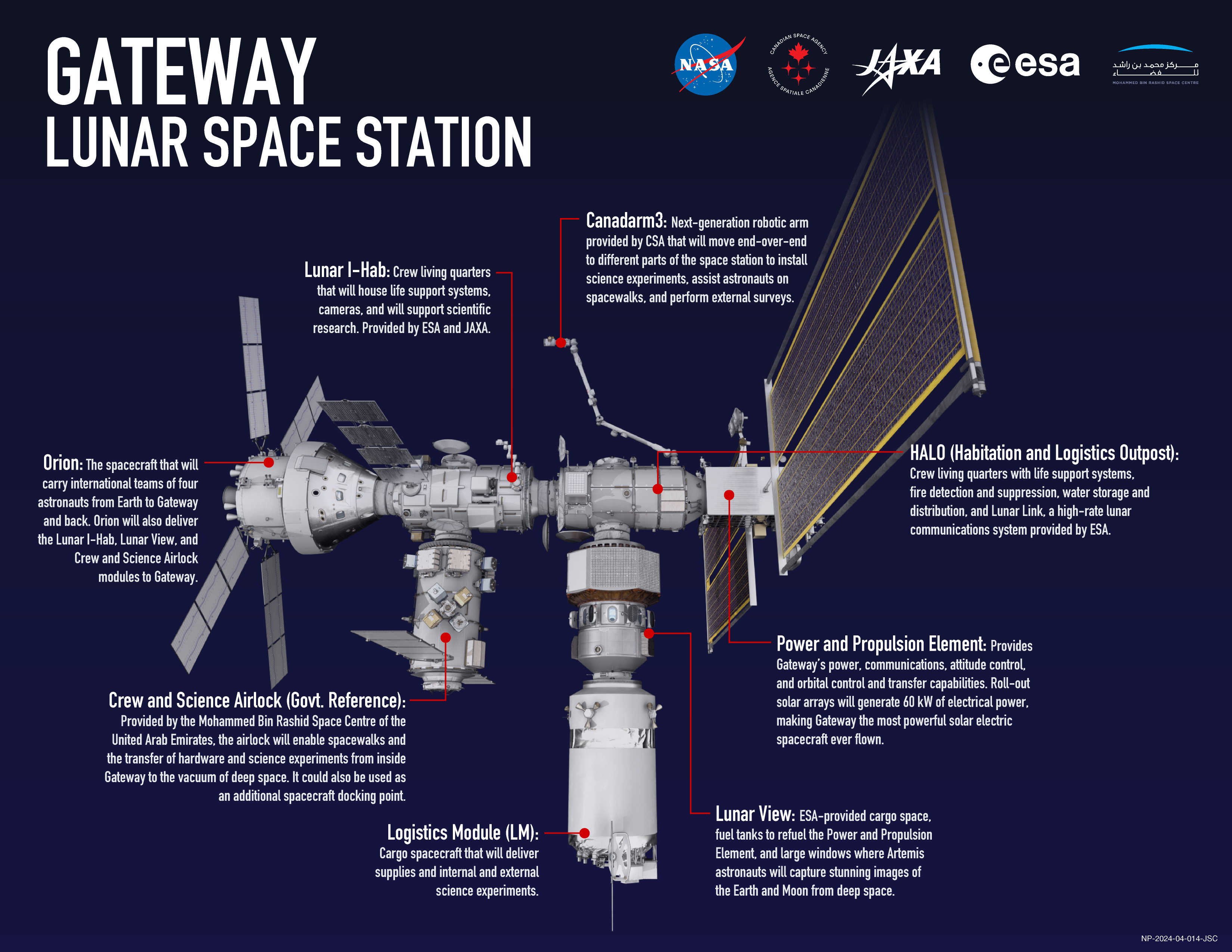
Schematic of the Lunar Gateway.
The Lunar Gateway.
Nasa

Most components contributed by these partners have already been produced and delivered to the US for integration and testing. But the project has been beset by rising costs and persistent debates over its value.

If cancelled, the US abandonment of the most multinational component of the Artemis programme, at a time when trust in such alliances is under unprecedented strain, could be far reaching.

It will be assembled module by module, with each partner contributing components and with the possibility of additional partners joining over time.

Strategic aims

Gateway reflects a broader strategic aim of Artemis, to pursue lunar exploration through partnerships with industry and other nations, helping spread the financial cost – rather than as a sole US venture. This is particularly important amid intensifying competition – primarily with China.

China and Russia are pursuing their own multinational lunar project, a surface base called the International Lunar Research Station. Gateway could act as an important counterweight, helping reinforce US leadership at the Moon.

In its quarter-century of operation, the ISS has hosted more than 290 people from 26 countries, alongside its five international partners, including Russia. More than 4,000 experiments have been conducted in this unique laboratory.

In 2030, the ISS is due to be succeeded by separate private and national space stations in low Earth orbit. As such, Lunar Gateway could repeat the strategic, stabilising role among different nations that the ISS has played for decades.

However, it is essential to examine carefully whether Gateway’s strategic value is truly matched by its operational and financial feasibility.

It could be argued that the rest of the Artemis programme is not dependant on the lunar space station, making its rationales increasingly difficult to defend.

Some critics focus on technical issues, others say the Gateway’s original purpose has faded, while others argue that lunar missions can proceed without an orbital outpost.

Sustainable exploration

Supporters counter that the Lunar Gateway offers a critical platform for testing technology in deep space, enabling sustainable lunar exploration, fostering international cooperation and laying the groundwork for a long term human presence and economy at the Moon. The debate now centres on whether there are more effective ways to achieve these goals.

Despite uncertainties, commercial and national partners remain dedicated to delivering their commitments. Esa is supplying the International Habitation Module (IHAB) alongside refuelling and communications systems. Canada is building Gateway’s robotic arm, Canadarm3, the UAE is producing an airlock module and Japan is contributing life support systems and habitation components.

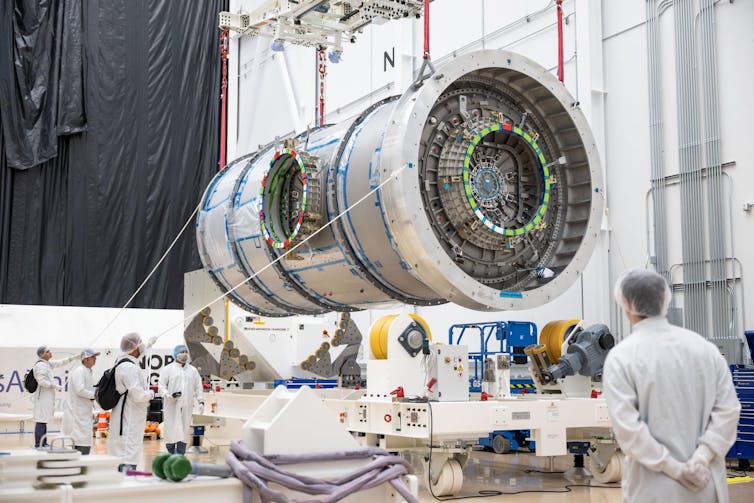
Gateway’s Halo module at a facility in Arizona operated by aerospace company Northrop Grumman.
Nasa / Josh Valcarcel

US company Northrop Grumman is responsible for developing the Habitat and Logistics Outpost (Halo), and American firm Maxar is to build the power and propulsion element (PPE). A substantial portion of this hardware has already been delivered and is undergoing integration and testing.

If the Gateway project ends, the most responsible path forward to avoid discouraging future contributors to Artemis projects would be to establish a clear plan to repurpose the hardware for other missions.

Cancellation without such a strategy risks creating a vacuum that rival coalitions, could exploit. But it could also open the door to new alternatives, potentially including one led by Esa.

Esa has reaffirmed its commitment to Gateway even if the US ultimately reconsiders its own role. For emerging space nations, access to such an outpost would help develop their capabilities in exploration. That access translates directly into geopolitical influence.

Space endeavours are expensive, risky and often difficult to justify to the public. Yet sustainable exploration beyond Earth’s orbit will require a long-term, collaborative approach rather than a series of isolated missions.

If the Gateway no longer makes technical or operational sense for the US, its benefits could still be achieved through another project.

This could be located on the lunar surface, integrated into a Mars mission or could take an entirely new form. But if the US dismisses Gateway’s value as a long term outpost without ensuring that its broader benefits are preserved, it risks missing an opportunity that will shape its long term influence in international trust, leadership and the future shape of space cooperation.The Conversation

Berna Akcali Gur, Lecturer in Outer Space Law, Queen Mary University of London

This article is republished from The Conversation under a Creative Commons license. Read the original article.

Continue Reading

Ticker Views

South Korea introduces AI job protection legislation

South Korea is proposing laws to protect jobs from AI, balancing innovation with workers’ rights amid rising automation.

Published

on

South Korea is proposing laws to protect jobs from AI, balancing innovation with workers’ rights amid rising automation.


South Korean lawmakers are taking bold steps to protect workers from the growing impact of AI on employment. The proposed legislation aims to safeguard jobs and support workers transitioning into new roles as machines increasingly enter the workforce.

Professor Karen Sutherland of Uni SC joins Ticker to break down what these changes mean for employees and industries alike. She explains how the laws are designed to balance technological innovation with workers’ rights, and why proactive measures are crucial as AI adoption accelerates.

With major companies like Hyundai Motor introducing advanced robots, labour unions have raised concerns about fair treatment and the future of human labour. Experts say South Korea’s approach is faster and more comprehensive than similar initiatives in the United States and European Union, aiming to secure livelihoods while improving the quality of life for displaced workers.

Subscribe to never miss an episode of Ticker – https://www.youtube.com/@weareticker

#AIJobs #SouthKorea #FutureOfWork #Automation #TechPolicy #LaborRights #WorkforceInnovation #Ticker


Download the Ticker app

Continue Reading

Ticker Views

U.S. ambassador responds to NATO criticism at Munich Security Conference

At Munich Security Conference, U.S. NATO ambassador discussed defense autonomy, hybrid warfare, and transatlantic cooperation amid rising tensions.

Published

on

At Munich Security Conference, U.S. NATO ambassador discussed defense autonomy, hybrid warfare, and transatlantic cooperation amid rising tensions.


At the Munich Security Conference, the U.S. ambassador to NATO faced tough questions on global order as European allies explored greater defense autonomy amid rising geopolitical tensions. The discussion highlighted the challenges NATO faces in maintaining unity while responding to evolving threats.

The ambassador addressed criticisms directly, emphasizing the importance of transatlantic cooperation and NATO’s role in ensuring international security. European nations voiced concerns about independent defense capabilities and the impact of hybrid warfare from Russia on regional stability.

Oz Sultan from Sultan Interactive Group provides analysis.

Subscribe to never miss an episode of Ticker – https://www.youtube.com/@weareticker

#MunichSecurityConference #NATO #GlobalSecurity #DefenseAutonomy #Geopolitics #TransatlanticAlliance #HybridWarfare #USForeignPolicy


Download the Ticker app

Continue Reading

Trending Now