
International vaccination passports are arriving in Australia
Australians will begin using an international vaccine passport from October as a way to prove their vaccination status overseas and on their return to the country.
The country’s Prime Minister Scott Morrison today outlined that home quarantine will be key to reopening international borders.
Scott Morrison is also asking state and territory leaders about how they plan to integrate vaccination certificates into existing check-in apps, such as ‘Services Victoria’ – and plans to request state’s timelines on introducing home quarantine.
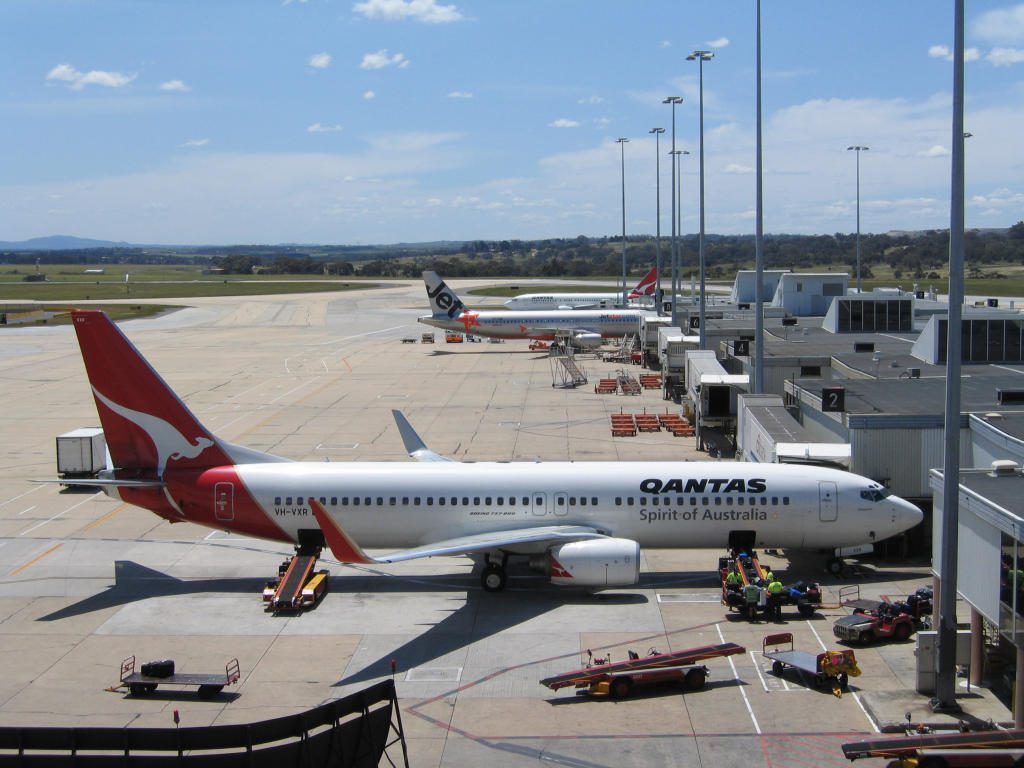
Under the nation’s reopening plan, Prime Minister Scott Morrison has suggested overseas travel will resume when states reach the 80 per cent vaccination threshold
Currently, around 40 per cent of the population in Australia aged over 16 is fully vaccinated against COVID-19.
All travellers coming to Australia must undertake a mandatory two-week hotel quarantine period regardless of their vaccination status.
NSW Premier Gladys Berejiklian confirmed that considerations were underway for what quarantine looks like for returning Australians, once vaccine targets are reached.
“There will be a transition in the quarantine system from 70 per cent double dose to 80 per cent double dose,”
NSW Premier Gladys Berejiklian said.
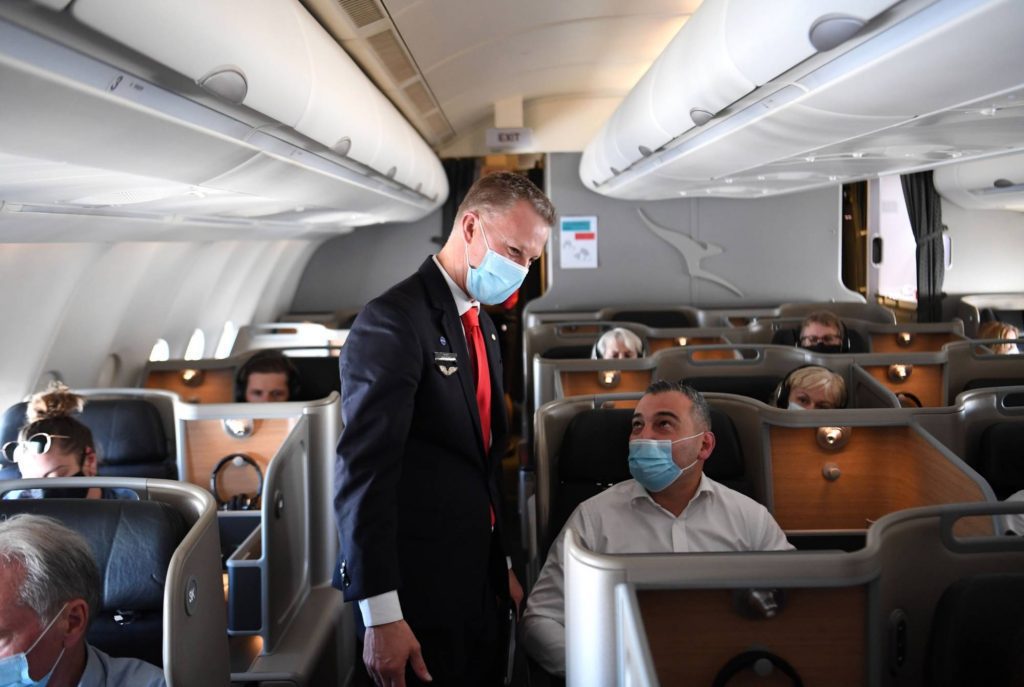
Qantas staff talk to passengers onboard a flight bound for Auckland on April 19.
“Once we hit 80 per cent double dose we will definitely be opening up Sydney Airport to welcome home Australians.”
A home quarantine system is currently being trialled in South Australia, allowing residents arriving from NSW and Victoria to quarantine at their residence.
Tensions rise in Minneapolis after fatal shooting by ICE agent, sparking protests and unrest as investigations unfold.
Tensions in Minneapolis have escalated following the fatal shooting of a mother by a U.S. Immigration agent. The incident has sparked outrage across the city, with residents taking to the streets to demand justice. Authorities are struggling to contain the unrest as public anger continues to mount.
State and federal officials are now at odds over the investigation. The Minnesota Bureau of Criminal Apprehension has stepped back after the FBI assumed control, while the state attorney general has warned that state-level charges could still be pursued independently. The political divide adds another layer of complexity to an already volatile situation.
In response to the protests, schools in Minneapolis have closed and the National Guard has been activated to maintain order. Citizens are being urged to stay safe as tensions remain high and the city braces for further demonstrations.
Subscribe to never miss an episode of Ticker – https://www.youtube.com/@weareticker
Iran faces widespread protests as currency collapse and soaring inflation strain household budgets, fueling public anger.
Protests are spreading across Iran after the country’s currency suffered a dramatic collapse, pushing inflation to more than 42 percent in December. Rising prices are squeezing household budgets, with basic goods becoming increasingly unaffordable for millions of Iranians.
What began as frustration over the cost of living has quickly grown into widespread public anger, as families struggle to keep up with soaring expenses amid a weakening rial and economic uncertainty.
These economic pressures have become the catalyst for demonstrations across major cities, marking one of the most serious waves of unrest linked directly to inflation in recent years.
Subscribe to never miss an episode of Ticker – https://www.youtube.com/@weareticker
PM announces royal commission to address anti-Semitism and social cohesion following pressure from various communities and leaders
In Short:
– Anthony Albanese has announced a royal commission into anti-Semitism and social cohesion, led by Virginia Bell.
– The inquiry aims to foster unity in Australia amid rising tensions and concerns from various community groups.
Anthony Albanese has initiated a commonwealth royal commission into anti-Semitism and social cohesion following mounting pressure.
The inquiry, announced in Canberra, will be led by former High Court justice Virginia Bell, despite opposition from some Jewish groups.The Prime Minister stated the need for a royal commission was essential for promoting unity within Australia, particularly after engaging with families of Bondi attack victims and the Jewish community.
He confirmed discussions with NSW Premier Chris Minns and expects the single commission to run over the next 12 months, with further comments from Mr Minns anticipated soon.
The prime minister has been asked if he’s still worried a royal commission would fuel antisemitism.Anthony Albanese insists he doesn’t want the inquiry to weaken social cohesion.
“The royal commissioner will bear in mind how hearings are conducted in the processes of their conduct,” Albanese says.
“We have been working on this for weeks. I have been engaged with the community.”
The prime minister was questioned about whether it was a mistake to reject calls for a royal commission into antisemitism.Following the Bondi terror attack, the federal government faced pressure to establish such a commission.
Anthony Albanese stated that the government has implemented various measures within the 25 days following the attack.
“We have increased funding for security agencies. We have had daily briefings of the National Security Committee,” Albanese says.
“The Commonwealth have particular resources and one of the groups and individuals I’ve spoken to as well have been people outside of New South Wales,” he says.
Highly-respected former High Court judge Justice Virginia Margaret Bell is the PM’s pick to lead the royal commission.
Sustained advocacy
This decision comes after sustained advocacy from various groups, including victims’ families, former leaders, and prominent figures across sectors.
Over recent weeks, Albanese and his team had put forth several arguments against a royal commission, such as concerns over divisiveness and potential exposure of sensitive information.
Gamel Kheir from the Lebanese Muslim Association has suggested that a broader inquiry into all forms of “minority religion” discrimination is needed, expressing wariness within the Muslim community regarding the federal inquiry’s focus.
Broad Support
A significant number of community and cultural organisations back a royal commission addressing social tensions and discrimination related to the Israel-Gaza conflict.
In support of this sentiment, nearly 50 diaspora and faith groups released an open letter urging a thorough examination of rising anti-Semitism and related issues following the Bondi Beach terror attack.