
Connect with us
https://tickernews.co/wp-content/uploads/2023/10/AmEx-Thought-Leaders.jpg

Ticker Views

Attorney General Merrick Garland: the iceberg cometh for Trump

Published

on

A week later and Washington, the political class, the media and much of the country are still reeling from the USS Trump’s collision with the iceberg that is the Attorney General of the United States, Merrick Garland

Only a portion of the AG’s work is visible above the surface, but beneath is a massive juggernaut that can inflict serious damage on those who collide with it.  Trump is listing, his momentum slowed.

Trump does not own the documents from his presidency, whether they were classified or not, whether he took them out of the White House or not, whether he destroyed any or not.  

The website of the National Archives of the United States is absolutely clear:

The Presidential Records Act (PRA) of 1978, 44 U.S.C. ß2201-2209, governs the official records of Presidents and Vice Presidents that were created or received after January 20, 1981 (i.e., beginning with the Reagan Administration). The PRA changed the legal ownership of the official records of the President from private to public, and established a new statutory structure under which Presidents, and subsequently NARA [National Archives], must manage the records of their Administrations. 

No president, current or former, owns presidential records.  The American people do.

Trump took boxes of documents from the White House on January 20, 2021, the day he left office and became the former president.  The National Archives has tried to track those down and have them returned ever since.  Finally, after months of efforts, several boxes were recovered.  But not all, and the Archives obtained a subpoena for the rest.  Trump never responded to it.  Finally, after showing a Federal judge the necessity of recovering the documents – principally because of the national security implications of the materials –  the AG obtained a search warrant and Garland approved the FBI search of Mar-a-Lago. Multiple boxes and documents were recovered.

No former president has ever been subject to such a law enforcement action. 

Former U.S. President Trump

Richard Nixon was pardoned for his Watergate crimes by President Gerald Ford, insulating him from further investigation.  No other former president has aroused any such concerns about the lawfulness of their activities after leaving office.  No other former president was impeached twice or treated the basic rules of the handling of intelligence matters with such contempt. 

For Trump – and especially for Trump’s base and his supporters, who yearn for his restoration – the raid  was a vicious persecution by the Deep State, the Regime, who wants him destroyed politically.  . Trump extremists have labelled the FBI as traitorous, and calls to defund the bureau.  

But as these events unfolded, and the seriousness of the reckless handling of these documents became evident – especially those that are top secret, and which can only be held and viewed under stringent security protocols – the mood among some Republicans has shifted.

There are real issues here which are adding to the baggage Trump is carrying as he prepares to declare for the 2024 presidential campaign – baggage which makes him less attractive to those Republicans who want to turn the page on Trump and his obsession with the past and instead turn to the future.

What is also extraordinary is how Trump can continue to dominate the news cycle.  The intensity of coverage over this last week rivalled the frenzy in 2017-19 over Special Prosecutor Robert Mueller’s investigation of the Trump campaign’s ties with Russia and whether Trump obstructed justice. 

The past week has been a breathless, wall-to-wall engagement.
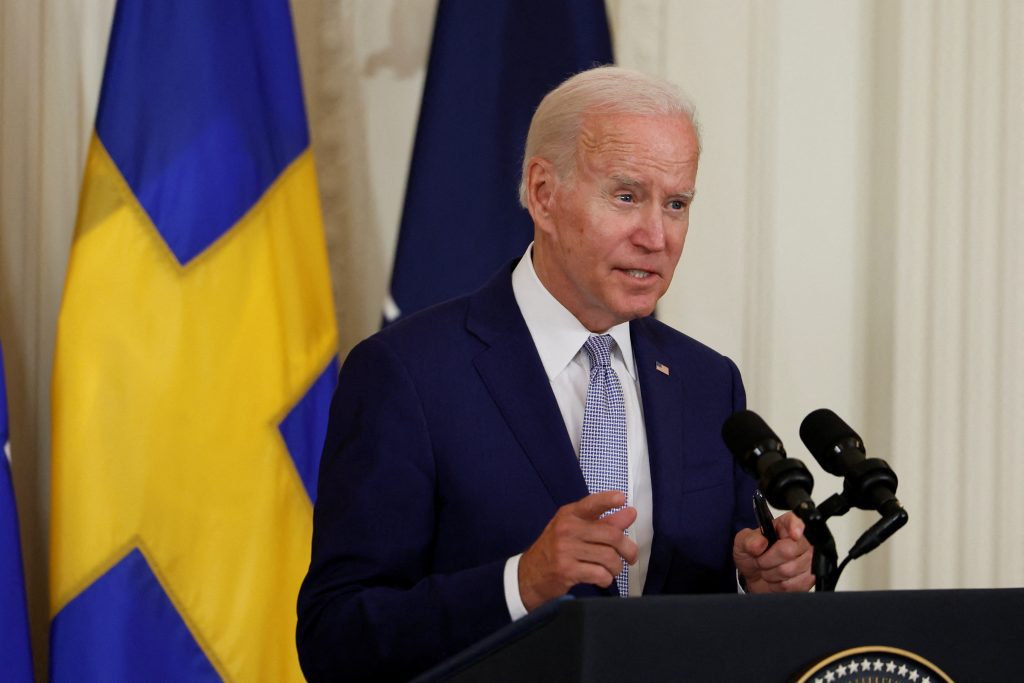
U.S. President Joe Biden delivers remarks and signs documents endorsing Finland’s and Sweden’s accession to NATO, in the East Room of the White House, in Washington, U.S., August 9, 2022. REUTERS/Evelyn Hockstein

And it has pushed to below the fold on p1 what the current president, Joe Biden, has achieved.  Biden has had his best two months since taking office:  a black woman jurist has joined the Supreme Court, a bipartisan gun safety bill was signed into law, a bipartisan multibillion program to secure America’ s leadership in computer chips, and all they drive in our economy, is now law.  Gasoline prices have declined 20% from their peak.  Inflation is slowing.  Congress has passed – and Biden will sign into law this week – the largest investment in clean energy in the history of US environmental law, lower prescription drug process and health insurance costs, and minimum taxes on the biggest corporations in the country. 

Together with last year’s Covid recovery programs and the trillion-dollar infrastructure investment to rebuild the country, and with leadership with allies on Ukraine – the Senate approved Sweden and Finland joining NATO –  Biden now has a record of a consequential president.

A wave of anger about the Trump Supreme Court’s repeal of a woman’s constitutional right to abortion is moving across the country – even in conservative states like Kansas.  Women trapped in states hostile to reproductive health care are getting the message:  the only way to restore abortion rights is to vote for Democrats.

The bottom line is that prospects for the Democrats for the midterm elections have improved.  

The FBI raid on Mar-a-Lago follows the weeks of hearings this summer of the January 6 Committee. 

What has been presented is an exceptionally compelling case of a conspiracy conceived and executed by Trump and his minions to overturn the presidential election he lost in 2020.

There has been immense pressure by many Democrats, historians, and legal experts for the Attorney General to seek Trump’s indictment for the insurrection and attack on the Capitol. 

There has been open frustration from these advocates that Garland, in the face of Trump posing a clear and present danger to America’s democracy, is not moving fast enough – is not sufficiently committed – to bringing Trump to justice.

What the past week shows is that they are only seeing the tip of the Garland iceberg.  It is clear from the FBI raid that Garland has been working quietly and deliberately to ensure that Trump is not above the law. There may yet be indictments for violation of the Espionage Act and other national security laws.  There is a grand jury currently working on the very issues posed by the insurrection. It is the biggest investigation in the history of the Justice Department.  Many witnesses who testified before the January 6 Committee are appearing before the grand jury.

Trump may well collide – again – with the Garland iceberg. It could be titanic.

Bruce Wolpe is a Ticker News US political contributor. He’s a Senior Fellow at the US Studies Centre and has worked with Democrats in Congress during President Barack Obama's first term, and on the staff of Prime Minister Julia Gillard. He has also served as the former PM's chief of staff.

Ticker Views

U.S. ambassador responds to NATO criticism at Munich Security Conference

At Munich Security Conference, U.S. NATO ambassador discussed defense autonomy, hybrid warfare, and transatlantic cooperation amid rising tensions.

Published

on

At Munich Security Conference, U.S. NATO ambassador discussed defense autonomy, hybrid warfare, and transatlantic cooperation amid rising tensions.


At the Munich Security Conference, the U.S. ambassador to NATO faced tough questions on global order as European allies explored greater defense autonomy amid rising geopolitical tensions. The discussion highlighted the challenges NATO faces in maintaining unity while responding to evolving threats.

The ambassador addressed criticisms directly, emphasizing the importance of transatlantic cooperation and NATO’s role in ensuring international security. European nations voiced concerns about independent defense capabilities and the impact of hybrid warfare from Russia on regional stability.

The conversation also covered Arctic strategy cooperation and the broader implications for NATO policies and transatlantic relations. For more, I’m joined by Oz Sultan from Sultan Interactive Group.

Subscribe to never miss an episode of Ticker – https://www.youtube.com/@weareticker

#MunichSecurityConference #NATO #GlobalSecurity #DefenseAutonomy #Geopolitics #TransatlanticAlliance #HybridWarfare #USForeignPolicy


Download the Ticker app

Continue Reading

Ticker Views

Israeli President Herzog visits Australia amid rising antisemitism

Israeli President Herzog’s Australia visit strengthens solidarity and shared values amid recent attacks on the Jewish community.

Published

on

Israeli President Herzog’s Australia visit strengthens solidarity and shared values amid recent attacks on the Jewish community.


Israeli President Isaac Herzog’s visit to Australia marks a significant moment of solidarity between the two nations, especially following recent tragic attacks affecting the Jewish community. The visit underscores shared democratic values and a commitment to combating antisemitism.

Professor Tim Harcourt from UTS discusses the deeper significance of the visit, including the Australian government’s message and the broader implications for Jewish Australians. The timing, following the Bondi attack, highlights the sensitive context in which this diplomatic engagement occurs.

Subscribe to never miss an episode of Ticker – https://www.youtube.com/@weareticker


Download the Ticker app

Continue Reading

Ticker Views

Rebuilding Gaza: Lessons from the Phoenix Plan

Published

on

What will a rebuilt Gaza look like? The competing visions for the Strip’s future

A girl walks along a street in Gaza to get food during the war between Hamas and Israel.
Jaber Jehad Badwan / Wikimedia Commons, FAL

Timothy J. Dixon, University of Reading; University of Oxford

Following a visit to Gaza in January, the UN undersecretary general, Jorge Moreira da Silva, called the level of destruction there “overwhelming”. He estimated that, on average, every person in the densely populated territory is now “surrounded by 30 tonnes of rubble”.

This staggering level of destruction raises urgent questions about how, and by whom, Gaza should be rebuilt. Since 2023, a variety of reconstruction plans and other initiatives have tried to imagine what Gaza could look like when the conflict ends for good. But which of these visions will shape Gaza’s future?

The Israeli government’s Gaza 2035 plan, which was unveiled in 2024, lays out a three-stage programme to integrate the Gaza Strip into a free-trade zone with Egypt’s El-Arish Port and the Israeli city of Sderot.

AI renderings show futuristic skyscrapers, solar farms and water desalination plants in the Sinai peninsula. The plan also shows offshore oil rigs and a new high-speed rail corridor along Salah al-Din Road, Gaza’s main highway that connects Gaza City and Rafah.

The US government has proposed a similar futuristic vision for Gaza. Its August 2025 Gaza Reconstitution, Economic Acceleration and Transformation Trust plan shows a phased series of modern, AI-powered smart cities developed over a ten-year time frame. The plan, which would place Gaza under a US-run trusteeship, suggested that poor urban design lies at the heart of “Gaza’s ongoing insurgency”.

Jared Kushner presenting the ‘Gaza Riviera’ Project at World Economic Forum in Davos, January 2026.

The latest iteration of this vision was unveiled by Donald Trump’s son-in-law, Jared Kushner, at the recent World Economic Forum in Davos.

He presented slides showing Gaza reconstructed as a “Riviera” of the Middle East, with luxury beachfront resorts, gleaming tower blocks, residential zones and modern transport hubs. Kushner suggested it was “doable” to complete the construction of a “new” Rafah city in “two to three years”.

It has been reported that the US and Israeli visions are heavily influenced by US-based economics professor Joseph Pelzman’s economic plan for Gaza. This plan, Pelzman said on a podcast in 2024, would involve destroying Gaza and restarting from scratch.

In contrast to the US and Israeli visions, the February 2025 Gaza “Phoenix” plan includes input from the people of Gaza. It has a much stronger focus on maintaining and reconstructing the existing buildings, culture and social fabric of the enclave.

The plan was developed by a consortium of international experts together with professionals and academics from Gaza, the West Bank and the Palestinian diaspora, and suggests a reconstruction and development phase of at least five years.

Other plans from the Arab world take a more technocratic view of reconstruction, but still have a short timescale for reconstruction. These include a five-year plan by the United Arab Emirates-based Al Habtoor Group, which promises to grant 70% of ownership in the holding company that will manage Gaza’s reconstruction to the Palestinians.

Feasibility of rebuilding Gaza

So, how feasible are these different visions and how inclusive are they for the people of Gaza? Rebuilding cities after war takes time and money, and also requires local resources. Even in China, a country with plentiful resources and abundant skilled labour, major new cities are rarely completed in less than 20 years.

And in Gaza rebuilding will be complicated by the fact that there are now 61 million tonnes of rubble there, as well as other hazardous debris such as unexploded munitions and human remains. This will need to be removed before any reconstruction can commence, with the UN estimating that clearing the rubble alone could take as long as 20 years.

For comparison, the Polish capital of Warsaw experienced a similar level of destruction during the second world war and it took four decades to rebuild and reconstruct the city’s historic centre. The time frames for reconstruction outlined in all of the plans for Gaza are far shorter than this and, even with modern construction methods, are unlikely to be feasible.

The US and Israeli visions also fail to include Palestinians in the planning of Gaza’s future, overlooking any need to consult with Gazan residents and community groups. This has led critics to argue that the plans amount to “urbicide”, the obliteration of existing cultures through war and reconstruction.

Reports that suggest Gazan residents will be offered cash payments of US$5,000 (£3,650) to leave Gaza “voluntarily” under the US plan, as well as subsidies covering four years of rent outside Gaza, will not have alleviated these concerns.

At the same time, the US plan does not propose a conventional land compensation programme for Gazan residents who lost their homes and businesses during the war. These people will instead be offered digital tokens in exchange for the rights to redevelop their land.

The tokens could eventually be redeemed for an apartment in one of Gaza’s new cities. But the plan also envisages the sale of tokens to investors being used to fund reconstruction. The Council on American-Islamic Relations, the largest Muslim civil rights and advocacy organisation in the US, says the “mass theft” of Palestinian land through the token scheme would amount to a war crime.

With their emphasis on community engagement and the repair and renewal of existing structures, the Phoenix plan and the other Arab-led visions are at least a step forward. But without a fully democratic consensus on how to rebuild Gaza, it is difficult to see how the voices of the Gazan people can be heard.

Whichever vision wins out, history shows that post-war reconstruction succeeds when it involves those whose lives have been destroyed. This is evidenced somewhat ironically by the US Marshall Plan, which funded the reconstruction of many European economies and cities after the second world war, and involved close engagement with civil society and local communities to achieve success.The Conversation

Timothy J. Dixon, Emeritus Professor in the School of the Built Environment, University of Reading; University of Oxford

This article is republished from The Conversation under a Creative Commons license. Read the original article.

Continue Reading

Trending Now