
North Korea has flown a missile over Japan for the first time in five years
U.S. Vice President Kamala Harris did not mince her words when she paid a visit to the demilitarised zone last week.
“In the North, we see a brutal dictatorship, rampant human rights violations and an unlawful weapons program that threatens peace and stability,” she said.
U.S. President Joe Biden spoke with Japan’s Prime Minister Fumio Kishida following Tuesday’s long-range missile. The pair condemned the test in the “strongest terms,” as they described it as a danger to the Japanese people.
Associate Professor Tilman Ruff from the University of Melbourne believes the threat of nuclear war has increased.
“This is clearly the time of greatest danger of nuclear war since the at least the Cuban missile crisis.”
North Korea has carried out over 30 missile tests this year, as authorities brace themselves for bigger weapon, which could reach the U.S. east coast.
The Musudan, or the Hwasong-10 is a medium-range ballistic missile, which has an estimated range of more than 4,000km.
The missile was first tested in October 2016 and is believed to be capable of reaching South Korea and Japan.
4. The KN-08
The KN-08 is a long-range ballistic missile, which boasts an estimated range of more than 6,000km.
While North Korea had two unsuccessful tests of this weapon in 2016, it was successfully tested in 2017.
North Korea’s leader Kim Jong-Un inspects his weaponry.
3. The Pukguksong-2
The Pukguksong-2 is a medium-range ballistic missile, which has an estimated range of more than 2,000km.
This is a land-based variant of the Pukguksong-1 weapon, which is submarine-launched.
The missile was first tested in February of 2017 and is believed to be capable of reaching South Korea and Japan.
2. The Hwasong-14
The Hwasong-14 is North Korea’s first intercontinental ballistic missile. It is also one of their most powerful missiles, with an estimated range of more than 8,000km.
The missile was first tested in July 2017 and is believed to be capable of reaching New York.
1. The Hwasong-12
The latest missile test over Japanese territory is understood to be an intermediate-range Hwasong-12.
This ballistic missile has an estimated range of more than 4,500km, and is believed to be capable of reaching the U.S. territory of Guam in the Pacific.
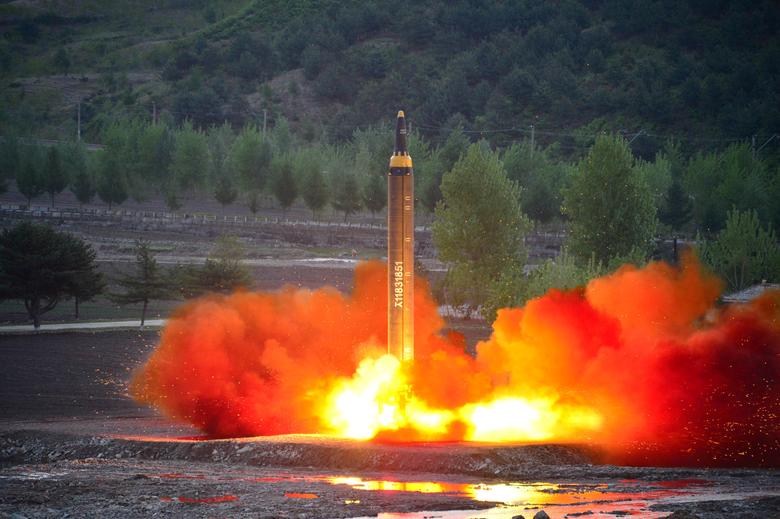
The long-range strategic ballistic rocket Hwasong-12.
North Korea’s missile tests have risen under the rule of its current leader, Kim Jong-Un. In fact, there have been more test launches this year, than in the previous decade alone.
“If anybody thought that the risk of nuclear war went away with the end of the Cold War, then these current concerns should put an end to any such complacency.”
Associate Professor Tilman Ruff, the University of Melbourne
There are also a range of other weapons in the North Korean inventory, including a nuclear bomb, which is believed to be six times bigger than what the U.S. dropped on Hiroshima in 1945.
Costa is a news producer at ticker NEWS. He has previously worked as a regional journalist at the Southern Highlands Express newspaper. He also has several years' experience in the fire and emergency services sector, where he has worked with researchers, policymakers and local communities. He has also worked at the Seven Network during their Olympic Games coverage and in the ABC Melbourne newsroom.
He also holds a Bachelor of Arts (Professional), with expertise in journalism, politics and international relations. His other interests include colonial legacies in the Pacific, counter-terrorism, aviation and travel.
Newly released court documents have revealed chilling details about the Bondi terror attack, marking one of Australia’s deadliest attacks in decades. Father-and-son duo Sajid and Naveed Akram allegedly spent months meticulously planning the assault, targeting the “Chanukah by the Sea” festival on Sydney’s Bondi Beach. Police say the pair rehearsed tactics, filmed extremist propaganda, and prepared multiple improvised explosive devices long before the attack that killed 15 people and injured dozens more.
Investigators allege the attack began with the men throwing four improvised bombs into a crowded festival of over 1,000 attendees. The devices, including pipe bombs and a “tennis ball bomb” packed with shrapnel, failed to detonate, but authorities have described them as “viable” IEDs. Moments later, the Akrams opened fire from a footbridge overlooking the festival, creating a scene of chaos and tragedy. Among the victims were a 10-year-old girl, a Holocaust survivor, and worshippers who attempted to confront the gunmen.
Court documents also reveal months of preparation, including firearms training in rural New South Wales. The pair was captured on video handling long-barrelled shotguns, moving tactically, and simulating an assault scenario. Additional footage shows the men seated in front of an Islamic State flag, guns and ammunition visible, as Naveed recites passages from the Quran and then outlines the ideological motivations behind the planned Bondi attack. Authorities say these materials demonstrate a pattern of premeditation and adherence to extremist ideology.
Overseas Islamist networks
Investigators also point to digital evidence recovered from Naveed’s phone, which includes a manifesto and detailed plans for the attack. Police allege the pair’s earlier month-long trip to the southern Philippines may have included contacts with overseas Islamist networks. Intelligence agencies previously reviewed Naveed for potential radicalisation in 2019, but concluded he did not pose a threat. Sajid Akram, meanwhile, legally owned six rifles and shotguns that were later used in the attack.
The human toll of the attack has had lasting impacts on the community. Survivors and witnesses recall the terror of that day as families gathered in celebration. Lawmakers have responded with urgency, including NSW Premier Chris Minns fast-tracked reforms to tighten firearm laws, ban public displays of terrorist symbols, and expand police powers. At a national level, Prime Minister Anthony Albanese has secured agreement from state and territory leaders to review and strengthen post-Port Arthur gun laws and introduce measures targeting extremist propaganda and hate speech.
The Bondi terror attack stands as a stark reminder of the devastating consequences of extremist planning and the importance of vigilant intelligence and community safety measures. While court proceedings continue, the public response underscores the shared grief and determination to prevent such tragedies in the future.
In Short:
– China has deployed over 100 ICBMs in new silos near Mongolia, marking a significant nuclear expansion.
– Beijing aims to enhance military strategies for Taiwan by 2027, potentially affecting U.S. operations in the region.
China has deployed over 100 solid-fueled intercontinental ballistic missiles (ICBMs) in newly constructed silo fields near its border with Mongolia, according to a draft Pentagon report reviewed by Reuters.This marks the most significant nuclear expansion by Beijing to date. The United States indicates that China shows no intention of engaging in arms control negotiations, despite President Trump’s calls for denuclearization talks with both China and Russia.
The report states that the DF-31 missiles, which have a range of 7,000 to 11,700 kilometers, are positioned across three silo fields. While the Pentagon had previously acknowledged these fields, this is the first confirmation of the number of deployed missiles.
China’s nuclear warhead stockpile was estimated at around 600 in 2024. The report projects an increase to over 1,000 warheads by 2030. It highlights a lack of willingness from Beijing to pursue arms control measures.
Beijing has dismissed such reports as attempts to discredit China and claims that it follows a nuclear strategy of self-defense with a no-first-use policy.
Forceful means
The Pentagon assessment indicates that China plans to be capable of fighting and winning a conflict over Taiwan by 2027. Beijing is reportedly enhancing military strategies to capture the island through forceful means.
These military strikes could potentially disrupt U.S. operations in the Asia-Pacific region.
Neither the Pentagon nor China’s embassy in Washington responded to requests for comment. U.S. officials cautioned that the draft report could change before its formal submission to lawmakers.
Australia’s property market is set for strong growth in 2026, driven by demand and strategic investments across key regions.
Australia’s property market is predicted to perform strongly in 2026, with no major losers expected as demand and prices rise across 14 key regions. Hotspotting’s latest analysis highlights which areas are set to shine and the factors driving this unprecedented growth.
Join Tim Graham from Hotspotting as he explains the methodology behind the price predictions and why infrastructure investments and government policies are playing a key role in shaping the market.
From regional hotspots to major cities, we explore emerging trends, buyer behavior, and the outlook for places like Darwin and Perth. Whether you’re a first home buyer or seasoned investor, this episode is packed with insights to navigate Australia’s booming property landscape.
Subscribe to never miss an episode of Ticker – https://www.youtube.com/@weareticker