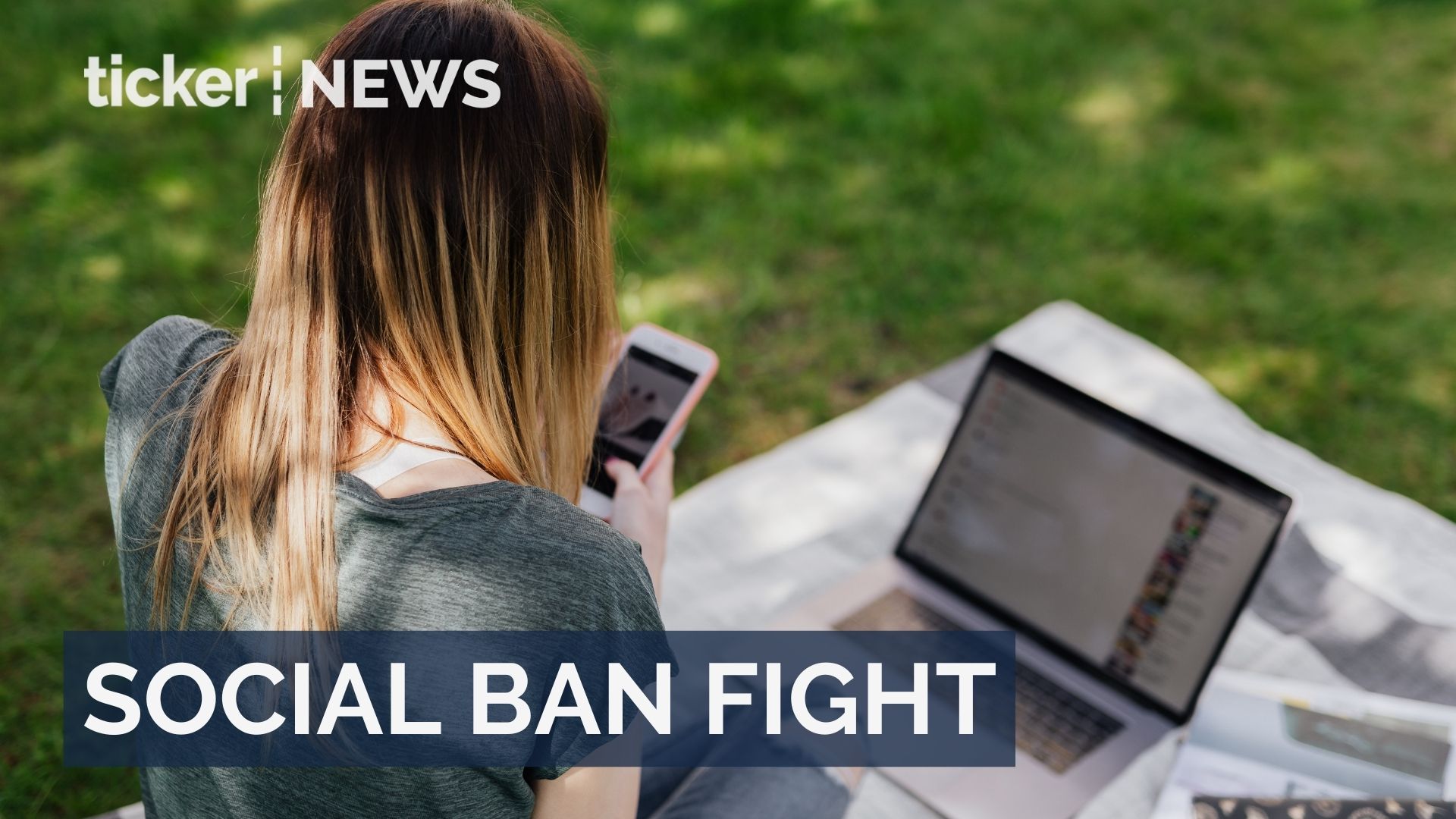
Two teenagers are taking the federal government to the High Court. They argue the ban on social media accounts for under-16s is unconstitutional because it interferes with free political communication.
The ban is due to take effect on December 10.
Will the High Court challenge make any difference?
What does the law do?
Due to a 1998 US law, social media platforms’ terms of service already set a minimum age of access of 13 years.
Australia’s new law imposes an obligation on some social media platforms to take reasonable steps to prevent users under 16 from having an account with the platform. The law does not impose obligations on under-16s themselves or on their families. This means only social media platforms can be guilty of breaking the law.
Australia’s eSafety Commissioner has announced the law applies to Facebook, Instagram, Snapchat, Threads, TikTok, Twitch, X, YouTube, Kick and Reddit.
The practical effect is that Australians aged under 16 will not be able to have accounts on those and similar social media platforms. But under-16s will still be able to access content on those platforms if they have a logged-out functionality.
The federal government says the law’s purpose is to “enhance the online safety and wellbeing of young people”.
The Office of Impact Analysis’ assessment of the law included a report from the Queensland Chief Health Officer stating “existing studies provide compelling indications of possible negative links between unrestrained social media usage and the cognitive, emotional, and social wellbeing of young people”.
The analysis also noted UK and US reports about the negative impacts of social media use on young people’s wellbeing.
Australia has lots of similar laws
Lots of laws restrict young people’s access to spaces and things that sometimes have political content, to protect their wellbeing.
Shops are banned from selling video games with certain classifications to teenagers, even though the games may have some political content. Cinemas are banned from selling tickets to movies with certain ratings to teenagers, even though the movies may have some political content. Liquor shops are banned from selling alcohol to under-18s, even though some alcohol-fuelled conversations turn political. And pubs are banned from allowing unaccompanied minors on their premises, even though there might be a bit of political banter at the bar.
So far, none of these laws has been found to be unconstitutional. However, more than one teenager has managed to circumvent these laws on occasion (as likely will also happen with the ban on social media accounts).
Who is bringing the High Court case?
The High Court case is being brought in the name of two 15-year-olds, Noah Jones and Macy Neyland.
They are backed by a group called the Digital Freedom Project, led by NSW upper house MP John Ruddick of the Libertarian Party. So far, the Digital Freedom Project has not revealed who is giving it money.
The case will argue that the law is unconstitutional because it impermissibly burdens the implied freedom of political communication.
What is the implied freedom of political communication?
The implied freedom of political communication arises from the Australian Constitution’s requirement that parliamentarians be “chosen” by the people. Without freedom to communicate about political matters, that choice would not really be a meaningful one.
The implied freedom of political communication is not an individual right. It is a limitation on parliament’s power to make laws. And it is not about free speech more generally. Political communication covers all matters of public and governmental affairs.
A law that burdens political communication will be invalid unless the law has a legitimate purpose and that purpose is pursued in a proportionate manner.
Does the social media account ban law burden freedom of political communication?
The plaintiffs need to persuade the High Court that the law will lead to a real reduction in political communication in Australia.
Former High Court Chief Justice Robert French said in a report considering a draft South Australian law similar to the new law:
The implied freedom of political communication would not seem to be engaged. The restriction is content neutral, is not directed at political speech and, in any event, is a reasonable and proportionate means for a legitimate purpose consistent with Australia’s representative democracy.
The Digital Freedom Project’s website says the law “places a heavy burden on political communication”. This seems exaggerated. Any reduction in political communication is slight: very few 13-, 14- or 15-year-olds use social media to create or engage with political content. Those who do are doing so only occasionally.
Is the law proportionate?
It is easier for governments to justify small burdens on political communication as proportionate to a legitimate purpose than it is to justify large burdens on political communication.
The Digital Freedom Project’s website accepts the law’s purpose of protecting young people’s wellbeing is legitimate. However, they say the law “fails proportionality because less restrictive and workable alternatives exist (parental consent pathways for 14- and 15-year-olds, platform duty of care and safe design settings, targeted moderation/takedown, age-appropriate feature gating rather than bans, digital literacy programs, and privacy preserving age assurance)”.
The Office of Impact Assessment has assessed some of those ideas as likely to be less effective than requiring social media platforms to not allow under-16s to have accounts. And some of those ideas look rather like asking the High Court to invent new legislative models, which it will not do.
What happens next?
The plaintiffs are asking the High Court to issue an urgent injunction preventing the government enforcing the law until the High Court has a chance to hear the case and make a final ruling. Injunctions like that are rare.
The law is due to come into effect on December 10. Unless the High Court grants an injunction, the law will take effect as planned, even if the constitutional challenge later succeeds.
The eSafety Commissioner’s website has a range of resources to help young people, their families and teachers get ready for the law coming into operation.
Luke Beck, Professor of Constitutional Law, Monash University
This article is republished from The Conversation under a Creative Commons license. Read the original article.